
15 September 2026 · Faheem M
AQI and Heart Health Explained: How Air Pollution Affects Your Heart
Learn how the Air Quality Index (AQI) affects heart health, what the research says about air pollution and cardiovascular disease, and practical steps to protect your heart.

Every time you check your phone for the weather, there's a good chance a small colored number sits right next to it: the Air Quality Index, or AQI. Most people glance at it to decide whether it's a good day for a run. Fewer realize that number is also a meaningful signal for heart health.
A growing body of research shows that air pollution isn't just a lung issue. It's one of the more overlooked, modifiable risk factors for heart disease. Here's what the science says about AQI and heart health, and what you can do with that information.
What Is the AQI and How Is It Calculated?
The AQI is a standardized scale, used in the U.S. by the EPA and in similar forms worldwide, that translates raw pollutant concentrations into a single number from 0 to 500. It's built primarily around fine particulate matter (PM2.5), ground-level ozone, and other pollutants like nitrogen dioxide and carbon monoxide.
The U.S. EPA updated its AQI breakpoints in 2024 to reflect newer health evidence, tightening the threshold for what counts as "good" air quality.
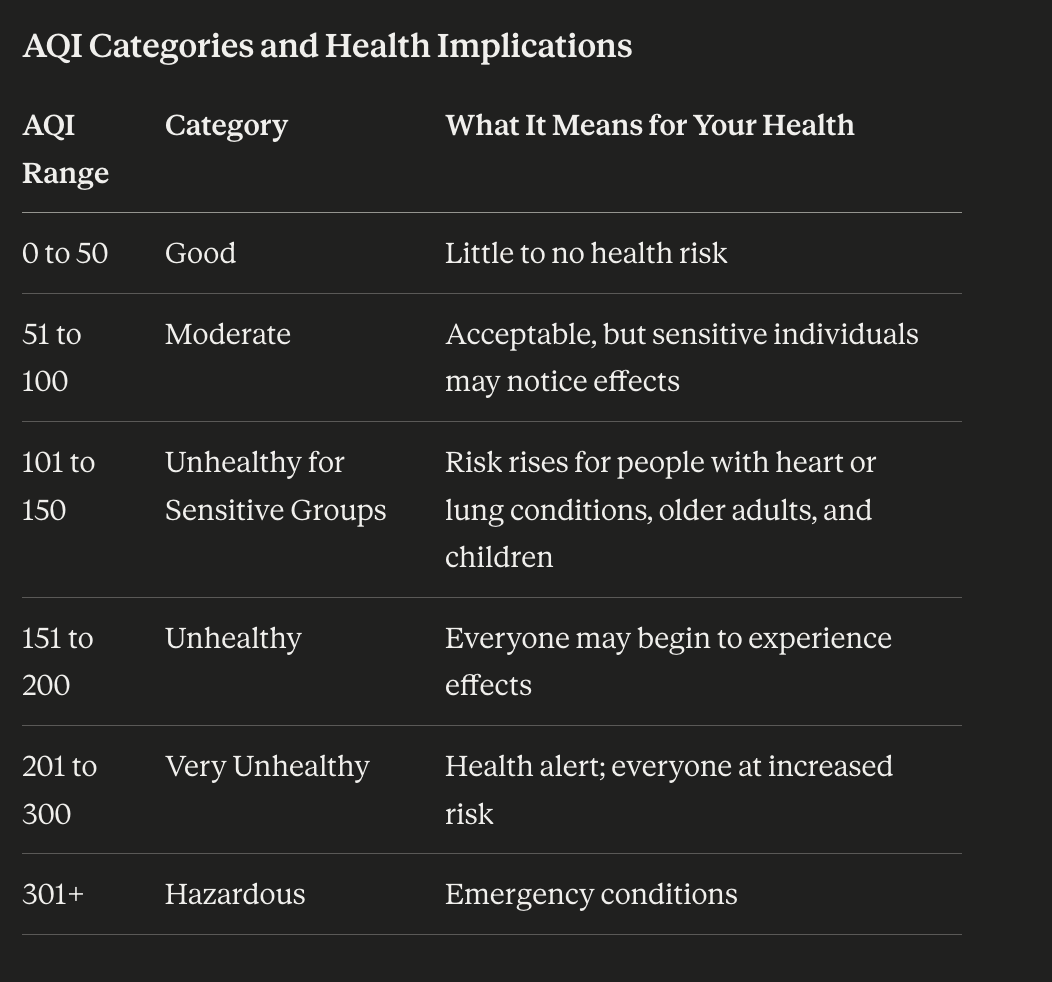
Notably, the "good" ceiling for PM2.5 dropped from 12.0 to 9.0 micrograms per cubic meter in 2024. This change was driven by evidence that harm occurs at lower concentrations than previously assumed.
How Air Pollution Affects the Heart
The link between air pollution and cardiovascular disease isn't new, but it's better understood today than ever before. The American Heart Association first issued a scientific statement on air pollution and cardiovascular disease in 2004, concluding that particulate matter exposure contributes to cardiovascular illness and death. That statement has since been updated as researchers mapped out the biological mechanisms more precisely.
In short: fine particles small enough to slip past the lungs' defenses can reach the bloodstream and trigger a cascade of effects that stress the cardiovascular system. The main mechanisms researchers point to include the following.
1. Oxidative Stress and Inflammation
Inhaled particles provoke an inflammatory response that doesn't stay confined to the lungs. It spreads systemically, contributing to processes that damage blood vessels over time.
2. Endothelial Dysfunction
The endothelium is the thin layer of cells lining blood vessels, and it plays a central role in keeping arteries flexible and open. Pollution exposure appears to disrupt this lining's normal function, nudging vessels toward constriction rather than relaxation.
3. Autonomic Nervous System Disruption
Some studies link pollution exposure to imbalances in the nervous system signals that regulate heart rate. This may help explain why arrhythmias and other rhythm disturbances have been observed following high-pollution episodes.
4. Accelerated Atherosclerosis
Longer-term exposure has been associated with faster buildup and destabilization of arterial plaque, the process underlying most heart attacks and many strokes.
5. Blood Pressure Elevation
Both short-term spikes and chronic exposure to particulate pollution have been linked to higher blood pressure, one of the biggest drivers of cardiovascular risk.
Together, these mechanisms give researchers a biologically plausible explanation for why high-AQI days show up in the data as measurable increases in heart attacks, strokes, heart failure hospitalizations, and cardiovascular deaths.
What the Research Says About AQI and Cardiovascular Disease
This connection isn't just theoretical. Multiple population-level studies back it up:
A 2023 study of emergency department visits in Chiang Mai, Thailand found measurable associations between AQI levels and visits for acute coronary syndrome, acute heart failure, and stroke.
A time-series analysis of cardiovascular and cerebrovascular mortality in Huizhou, China (2015 to 2021) found that AQI readings of 80 or higher were associated with a statistically significant rise in cardiovascular death risk, with effects that lagged by about a day and varied by age and sex.
A widely cited meta-analysis found that for every 10 µg/m³ increase in PM2.5, cardiovascular mortality rose by roughly 0.8%, with somewhat larger effects on respiratory mortality. These numbers sound small until you multiply them across entire populations exposed to pollution every day.
In the U.S., a Southern Community Cohort Study of more than 44,000 people linked long-term PM2.5 exposure to elevated cardiovascular disease risk, including heart attacks and stroke, in a population of Black and white participants across 12 states. These are populations that often face disproportionate pollution exposure.
The consistency across different countries, pollution sources, and study designs is part of why major health bodies now treat this relationship as well established rather than speculative.
Who Is Most at Risk From Poor Air Quality?
Air pollution affects everyone's cardiovascular system to some degree, but the risk isn't distributed evenly.
People with existing heart disease: Show the sharpest responses to pollution spikes.
Older adults: Face higher risk of cardiovascular events on high-AQI days.
People with diabetes or prior stroke: Are more vulnerable to pollution-related complications.
Children: Are considered a sensitive group, mainly for long-term developmental effects.
Outdoor workers and residents near pollution sources: People who work outdoors or live near highways, industrial zones, or wildfire-prone regions face more frequent high-AQI days.
How to Protect Your Heart on High-AQI Days
None of this means you're powerless. Research on personal protective strategies points to several steps that genuinely help.
Check the AQI Before You Plan Your Day
Treat it the way you'd treat a weather forecast: a quick daily habit that informs decisions about outdoor exercise, especially for anyone with a heart or lung condition.
Shift Outdoor Activity Instead of Canceling It
On moderate-to-unhealthy AQI days, walking instead of running, or exercising earlier or later when traffic-related pollution is lower, can meaningfully cut exposure without sacrificing activity altogether.
Improve Your Indoor Air Quality
Fine particles infiltrate indoor spaces too. A properly sized HEPA air purifier, particularly in bedrooms, can measurably reduce indoor PM2.5. Keeping windows closed during smoke events or high-pollution stretches, and using kitchen exhaust fans when cooking, also helps.
Avoid High-Traffic Routes
If you have to be outside, routes away from busy roads reduce exposure to the freshest, most concentrated vehicle emissions.
Manage the Cardiovascular Basics
None of the pollution-specific steps replace standard cardiovascular care. Not smoking, staying active, eating a heart-healthy diet, and controlling blood pressure and cholesterol remain the foundation. Pollution avoidance is additive, not a substitute.
Talk to Your Doctor if You Have Heart Disease
People with cardiovascular conditions may benefit from a personalized plan for high-AQI days, including guidance on medication timing or activity adjustments.
Frequently Asked Questions
Does AQI really affect heart health? Yes. Multiple studies link higher AQI and PM2.5 levels to increased risk of heart attacks, strokes, arrhythmias, and cardiovascular death, especially in people with existing heart disease.
What AQI level is unsafe for the heart? Effects can appear even in the "Unhealthy for Sensitive Groups" range (101 to 150), and risk increases further above 150. People with heart disease should take extra precautions once AQI passes 100.
Can air purifiers help protect the heart from pollution? Yes. HEPA air purifiers can meaningfully reduce indoor PM2.5 levels, which is one of the more effective personal strategies supported by research.
Is short-term exposure to bad air dangerous for the heart? Yes. Short-term spikes in air pollution have been associated with same-day and next-day increases in heart attacks, heart failure hospitalizations, and cardiovascular deaths.
The Takeaway
The AQI number on your weather app is more than a smog indicator. It's a real-time snapshot of a factor that measurably affects cardiovascular risk, backed by mechanisms researchers can trace from the lungs to the bloodstream to the blood vessel wall. You can't control the air outside your door, but checking the AQI and adjusting your day accordingly is a small, evidence-backed habit that adds up, especially for anyone already managing heart disease.
Sources
American Heart Association, "Particulate Matter Air Pollution and Cardiovascular Disease: An Update to the Scientific Statement"
American Heart Association, "Air Pollution and Cardiovascular Disease: A Statement for Healthcare Professionals"
Krismanuel, H. (2025). "Air pollution and cardiovascular diseases: mechanisms, evidence, and mitigation strategies." Journal of Medicine and Life
Surit et al. (2023). "Association between air quality index and effects on emergency department visits for acute respiratory and cardiovascular diseases." PLOS ONE
"Effects of Air Quality Index and meteorological factors on cardiovascular and cerebrovascular mortality in Huizhou, China." Frontiers in Public Health
Rich, D. et al., "Personal Strategies to Reduce the Cardiovascular Impacts of Environmental Exposures."
U.S. EPA / CDC, "Heart Disease, Stroke, and Outdoor Air Pollution"
AirNow, www.airnow.gov, real-time AQI lookup by location
This article is for general educational purposes and isn't a substitute for medical advice. If you have heart or lung disease, talk to your healthcare provider about how to manage activity and exposure on high-pollution days.
AQI and heart health · air quality index heart disease · air pollution cardiovascular disease · PM2.5 heart health · how air pollution affects the heart