15 September 2026 · Faheem M
Do Air Purifiers Really Work? What the Research Actually Shows
Do air purifiers really work, or are they hype? Here's what peer-reviewed studies say about HEPA filters, PM2.5 reduction, allergies, heart health, and what these devices can't do.

Air purifiers are one of those products that split people into two camps. Some swear by them. Others assume they're an expensive way to hum white noise into a room while doing very little else. So which is it?
The short answer, backed by a fairly large body of peer-reviewed research: yes, air purifiers work, but only certain kinds, only for certain pollutants, and only if you size and run them correctly. Here's what the evidence actually says.
Do Air Purifiers Actually Reduce Indoor Pollution?
Yes, and the data on this is fairly consistent. A 2018 meta-analysis in the journal Indoor Air reviewed multiple intervention studies and found that portable HEPA air purifiers reduced indoor PM2.5 concentrations by an average of 25 to 50%, an effect that held up across different home types, seasons, and locations.
Other studies land in a similar or even stronger range:
A systematic review found that air purifiers reduced PM2.5 concentrations by anywhere from roughly 23% to 92%, depending on the device, room, and conditions.
A 2022 field study in South Korea measured "actual efficacy" of air purifiers in real homes with different levels of airtightness and confirmed meaningful PM2.5 reductions, while noting that a leaky house works against the purifier.
Research on wildfire smoke specifically found that homes running HEPA purifiers had 40 to 60% lower indoor PM2.5 than homes without one during smoke events.
A study in Lowell, Massachusetts, tracked 67 low-income homes with gas stoves over a year and found that HEPA and carbon-filter purifiers cut nitrogen dioxide levels by 36% after being introduced.
The consistent theme: filtration-based purifiers reliably pull fine particles out of the air. The size of the effect depends heavily on room size, how airtight the space is, and how long the unit runs.
Do Air Purifiers Help With Allergies and Asthma?
The evidence here is also generally positive, though slightly more mixed than for raw particle reduction. Studies link HEPA purifier use to measurable drops in airborne allergens, and users in several trials reported fewer symptom days and reduced use of allergy medication. The benefit tends to be strongest for people reacting to dust mites, pet dander, and mold spores, since HEPA filters are particularly good at capturing particles in that size range.
That said, a purifier only filters what's airborne. It won't remove allergens embedded in carpets, bedding, or upholstery, which is why purifiers work best alongside regular cleaning and vacuuming, not as a replacement for it.
Can Air Purifiers Improve Heart Health?
This is where the research gets genuinely interesting, and it connects directly to the well-established link between air pollution and cardiovascular disease.
A study published in JAMA Internal Medicine found that just three days of using an affordable home air purifier reduced indoor fine particulate exposure in urban seniors and produced an average 3 to 4 mm Hg drop in systolic blood pressure. The effect was even larger in overweight participants, with reductions of 6 to 10 mm Hg. Researchers noted that even a 1 mm Hg reduction in average systolic blood pressure across a population could prevent thousands of coronary heart disease deaths a year.
A more recent randomized crossover trial published in JACC (Journal of the American College of Cardiology) tested real HEPA filtration against sham filtration in 154 adults living near highways. Participants with elevated blood pressure saw a significant reduction with real HEPA use compared to the sham period, though the effect was concentrated in people who already had high readings rather than the group as a whole.
Not every study agrees. A trial in public housing near a highway found no significant blood pressure change after three weeks of HEPA filtration, and even saw an unexpected rise in one inflammatory marker, a reminder that results vary by study design, exposure levels, and population. Larger ongoing trials, including one specifically studying heart failure patients in India, are working to settle exactly how strong and how durable these cardiovascular benefits are.
The fair summary: air purifiers show a real, biologically plausible cardiovascular benefit in multiple studies, strongest for people with elevated blood pressure or high outdoor pollution exposure, but the effect size varies and long-term outcomes (actual heart attacks and strokes prevented) haven't been directly proven yet.
What Air Purifiers Cannot Do
This is the part that gets left out of a lot of marketing copy.
They don't remove most gases without a carbon filter. A HEPA filter is built to trap particles, not gases like volatile organic compounds (VOCs) or cooking fumes. Only a purifier with a dedicated activated carbon layer addresses those.
They don't replace ventilation or source control. The EPA's own guidance ranks source control (removing or reducing the pollutant at its origin) and ventilation above air cleaning as the most effective strategies. A purifier is a supplement to those, not a substitute.
They don't clean settled dust. Anything already on surfaces has to be removed by cleaning. A purifier only affects what's currently airborne.
Ionizers and ozone generators are a different story entirely. These devices work by charging particles so they stick to surfaces, or by intentionally releasing ozone to react with odors. Multiple health agencies, including the EPA and California's Air Resources Board, warn against them. Ozone is a lung irritant on its own, no federal agency has approved ozone-generating devices for occupied spaces, and independent testing has repeatedly found ionizers less effective at removing dust, smoke, pollen, and mold than true HEPA filtration. If a device markets itself as adding ions, plasma, or ozone into the room rather than filtering the air, that's a reasonable signal to look elsewhere.
How to Actually Size an Air Purifier So It Works
A huge share of "my air purifier doesn't seem to do anything" complaints come down to sizing, not the technology itself. The number that matters is CADR (Clean Air Delivery Rate), not the "covers up to X square feet" claim printed on the box, since many manufacturers calculate that figure using only 2 air changes per hour (ACH), which is well below what's useful for allergies or smoke.
A practical formula:
Required CADR = Room square footage × 0.67 (for roughly 4 to 5 ACH, the range recommended for general allergy and asthma control)
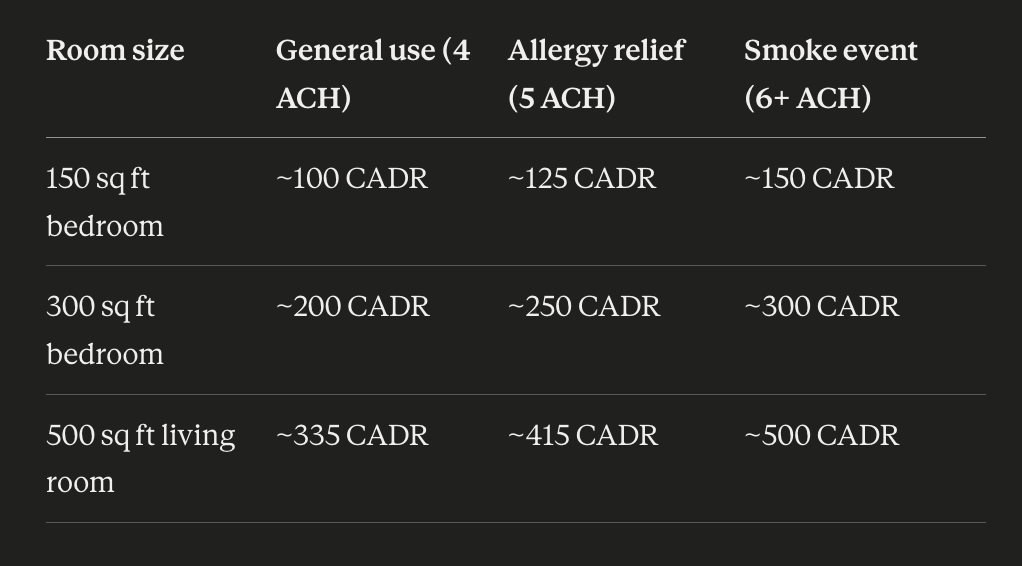
For heavier conditions like wildfire smoke or higher sensitivity needs, multiply the square footage by closer to 1.0, targeting 6 or more air changes per hour. A few reference points:
Look up a model's AHAM-verified CADR (from the AHAM Verifide directory) rather than trusting the coverage claim on the packaging, and size up if the ceiling is above 8 feet or the layout is open-plan.
So, Do Air Purifiers Really Work?
Yes, for what they're actually designed to do. True HEPA filtration reliably pulls fine particles, allergens, and smoke out of indoor air, with a growing body of evidence tying that reduction to lower blood pressure and better cardiovascular markers in at-risk groups. They are not a cure-all: they don't touch most gases without a carbon filter, they can't replace ventilation or cleaning, and ionizing or ozone-based "purifiers" should generally be avoided in favor of straightforward filtration.
The practical takeaway is less about whether the category works and more about buying the right one: a true HEPA (plus carbon, if odors or gases are a concern) unit, sized correctly for the room using CADR rather than the box's coverage claim, run consistently rather than occasionally.
Sources
Liang, Y. et al., "A meta-analysis of portable air purifiers on indoor PM2.5" Indoor Air (referenced via secondary summaries)
Shin, D. et al. (2022). "The Actual Efficacy of an Air Purifier at Different Outdoor PM2.5 Concentrations in Residential Houses with Different Airtightness." Toxics
"Evaluating the impact of air purifier intervention on particulate matter concentrations." Scientific Reports
Morishita, M. et al., "Effect of Portable Air Filtration Systems on Personal Exposure to Fine Particulate Matter and Blood Pressure in Residents of Public Housing." JAMA Internal Medicine, summarized via AAU
Brugge, D. et al. (2025). "Air purifiers may reduce cardiovascular risks from pollution and wildfires." JACC, summarized via Cardiovascular Business
"The PURI-HF (Air Purifiers on Heart Failure) Trial." ClinicalTrials.gov
U.S. EPA, "Guide to Air Cleaners in the Home"
Oransi, "What Is CADR? Calculator, Ratings & Room Size Guide."
AHAM Verifide directory, ahamverifide.org
This article is for general educational purposes and isn't a substitute for medical advice. If you have a heart condition, asthma, or another health concern related to air quality, talk to your healthcare provider about the right approach for your home.
airpurfiers