4 October 2026 · Faheem M
Mumbai AQI: Current Air Quality, Forecast & Health Guide
As the monsoon withdraws, Mumbai's air is slipping from clean to hazy, with live readings already touching "Unhealthy for Sensitive Groups." Here's where the city's AQI stands right now, why pollution climbs after the rains, what to expect through December, and simple ways to protect yourself and your family.

Mumbai's air is in the "Moderate" band right now, but the monsoon is leaving and the city's pollution season is about to begin.
If you looked out of a high-rise window on the morning of October 1, you probably noticed it: a grey-white veil hanging over the skyline. Parts of the city woke up under a thick haze, which a state pollution board official blamed on slow winds (Urban Acres). At the same time, the southwest monsoon is withdrawing, and the IMD expects daytime temperatures of 34–35°C this weekend.
That combination matters. For four months, rain has scrubbed Mumbai's air clean almost every day. Once it stops, dust and smoke start to linger. This guide covers where the AQI stands today, what the coming weeks look like, and how to protect yourself and your family.
Mumbai's air quality right now
On October 2, the official CPCB bulletin put Mumbai's 24-hour AQI at 110 — "Moderate" — with PM2.5 and PM10 as the main pollutants. That was a 31-point jump in a single day (Bombay Samachar, CPCB). Neighbouring Navi Mumbai (105) and Mira-Bhayandar (121) sat in the same band.
Private trackers that use the US AQI scale show much higher numbers for the same air:
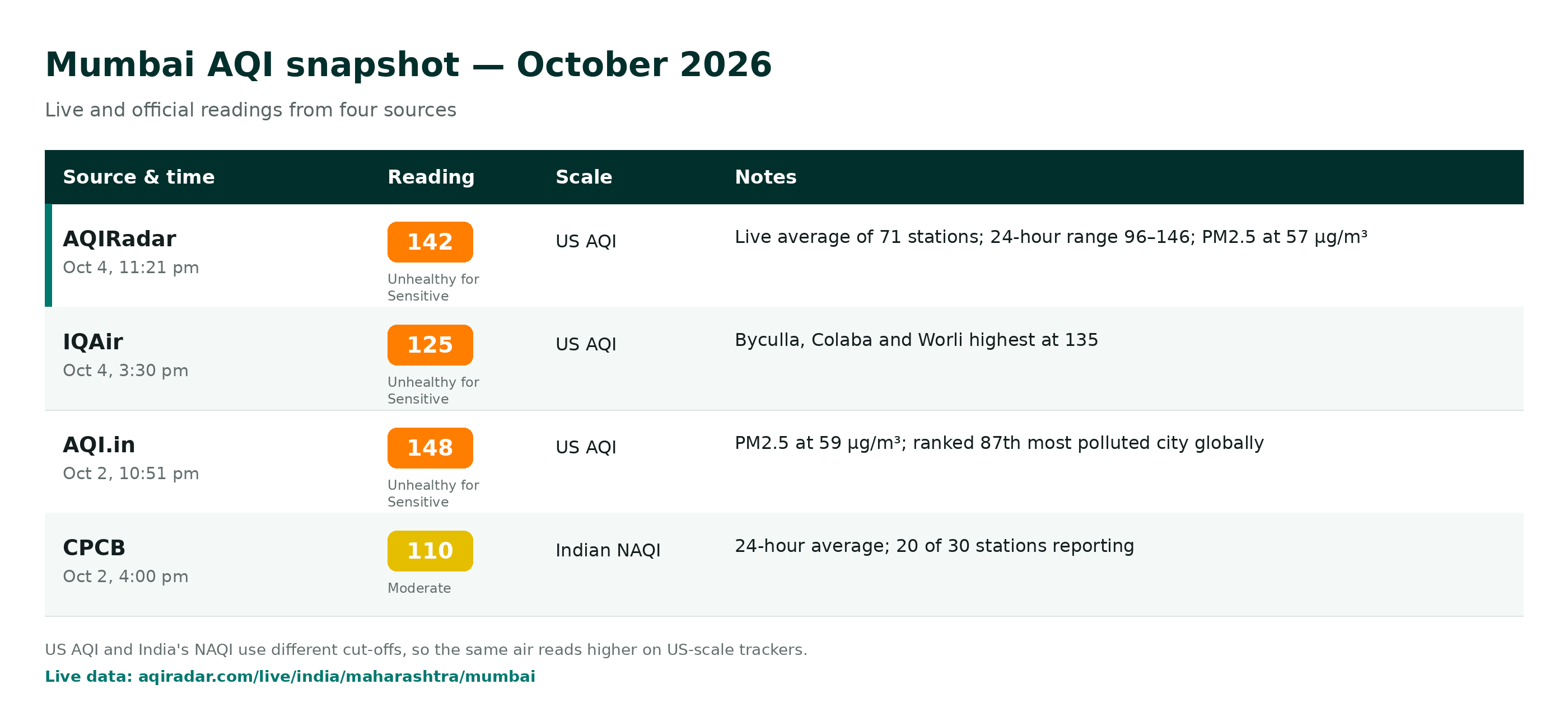
Check the live number: readings refresh hourly on AQIRadar's Mumbai live AQI page, where you can open any of the city's stations individually.
Insight: these numbers don't contradict each other. A US AQI of 125–150 and an Indian AQI of around 110 can describe the same air, because the two scales use different cut-offs (explained below). Also note the swing: from 189 late on October 1 to 118 the next evening. Mumbai's air changes fast with wind, so a single reading tells you little.
Hotspots: Worli recorded the city's poorest AQI, 169, on October 2 (Free Press Journal). South-central stations — Byculla, Colaba, Worli — keep showing up at the top of the rankings. One caution: only 19 of Mumbai's 30 monitoring stations were active that evening, so the city average has blind spots.
The live station spread shows how local pollution really is. On the night of October 4, AQIRadar recorded readings from 105 at Vidya Nagari to 237 at Dahisar East — a "Very Unhealthy" level, more than double the cleanest spot. Cama Industrial Estate (189) and Prabhadevi (171) were next worst. Your neighbourhood's reading matters more than the city average.
Why Mumbai's air worsens after the monsoon
Mumbai has the sea on three sides, so many people assume the breeze keeps the air clean. It usually does — until the wind drops. Post-monsoon, three things happen at once.
1. The rain stops washing the air. During the monsoon, rainfall pulls particles out of the atmosphere daily. When the BMC says the AQI will "plummet" after the rains, it points to drier air and the restart of construction as the twin triggers (Free Press Journal).
2. Winds slow down. Calm winds trap pollution close to the ground. Researchers have noted that changing weather patterns stop pollutants from dispersing quickly, despite the city's coastline (Deccan Herald). In past episodes, a sudden slowdown in wind alone pushed Mumbai's CPCB AQI from 206 to 262 overnight (Hindustan Times via PressReader).
3. Construction resumes at full speed. Dust is the city's biggest problem. In 2023, BMC officials identified construction dust and wind speed as the two main drivers, with over 5,000 active work sites in the city (Deccan Herald).
The BMC's own list of pollution sources goes well beyond construction (Hindustan Times via PressReader):
Road dust kicked back up by traffic
Open burning of garbage and waste
Dirty fuels in restaurants, bakeries and some households
Vehicle exhaust
Industry, including concrete batching and hot-mix plants
Crematoria and firecrackers
Insight: humidity cuts both ways. Moist, still air can make haze worse; in one winter episode, SAFAR blamed high humidity and low winds for keeping PM2.5 in the "Poor" range for days (Hindustan Times via PressReader). That's why a muggy, windless morning in Mumbai often looks the worst.
Forecast: what to expect from October to December
Expect a mostly "Moderate" October, with bad days becoming more frequent from November.
This week: IQAir's outlook for October 4 is a US AQI of about 110, with 13 km/h winds and 57% humidity (IQAir). Pollution officials expect the haze to clear whenever wind speeds pick up (Urban Acres). Expect good afternoons and hazier nights and early mornings.
November–December: this is historically the worst stretch. Between November 1 and December 10, 2022, Mumbai logged 22 days in the "Poor" or "Very Poor" categories, compared with only 6 in the same period a year earlier (Deccan Herald). Experts quoted then expected more such winter days in future years. Diwali firecrackers usually add a short, sharp spike.
What the city is doing: on October 2, the BMC released its Air Pollution Control and Enforcement Action Plan-2026 (Bombay Samachar). Key measures:
At least 10 pollution hotspots mapped and monitored in every ward
Strict enforcement of the 28-point guidelines at construction and demolition sites
A post-monsoon deep-cleaning drive in the first two weeks of October to clear mud, silt and dust
Debris movement tracked through the Mumbai Debris Control and Tracking System
Graded Response Action Plan (GRAP) measures that tighten as the AQI rises
The 28-point guidelines require sprinklers, fogging machines and barricades of at least 25 feet where needed, plus valid pollution certificates for material trucks (Free Press Journal).
Insight: rules are not the bottleneck. The Bombay High Court has said the laws already exist and what's missing is consistent implementation (The Hindu via PressReader). It later set up an independent five-member committee to inspect construction sites (Free Press Journal). How well the 2026 plan is enforced will decide whether this winter looks like 2022 or better.
How to read an AQI number
India's National AQI turns readings of eight pollutants into one number from 0 to 500, sorted into six categories (Arthapedia, IES). The worst single pollutant decides the category, even if the other seven look fine.
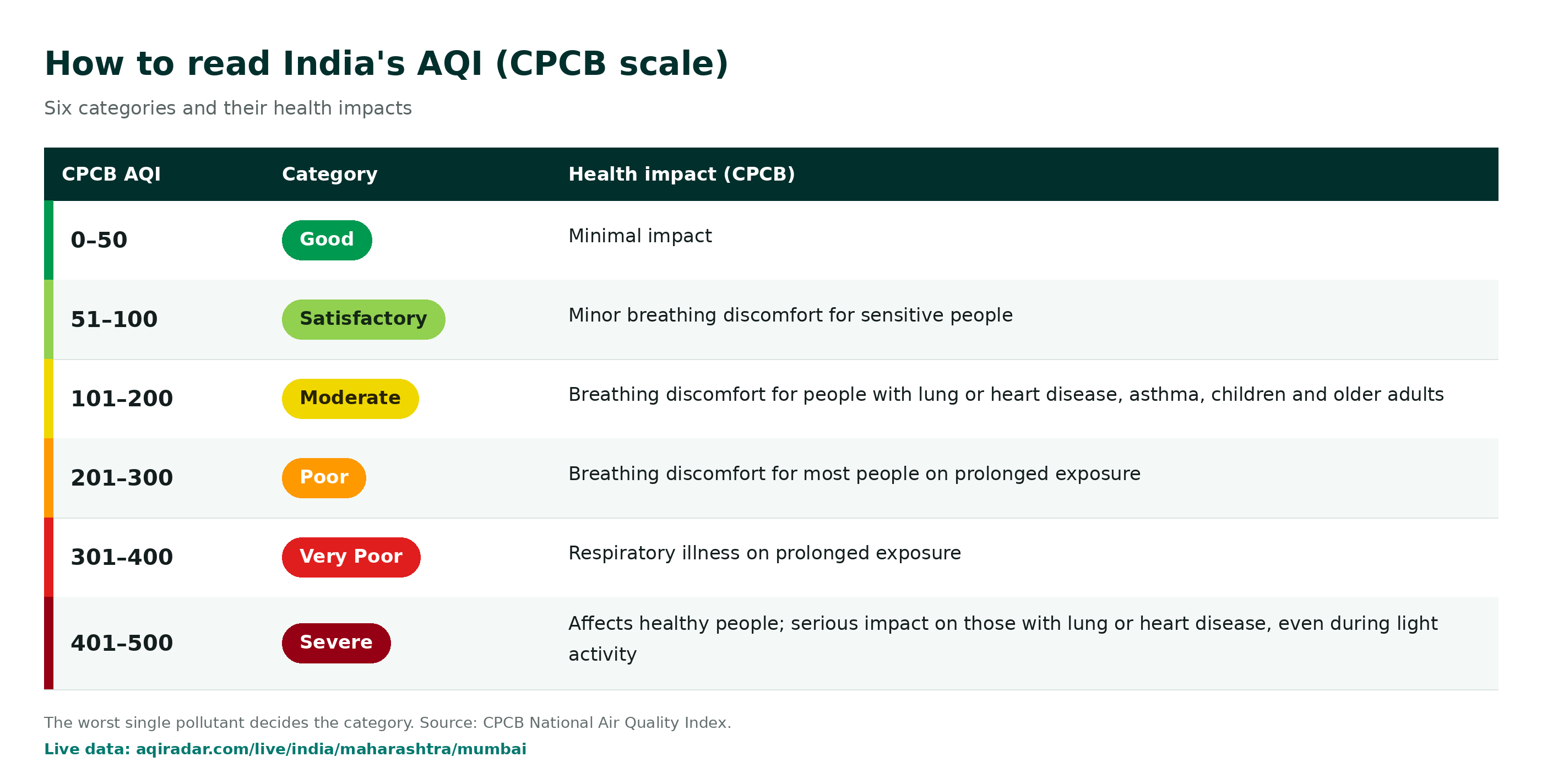
Sources: Arthapedia, IES, The Tribune.
CPCB vs US AQI: apps like IQAir and AQI.in convert readings to the US EPA scale, which is stricter about PM2.5. The same air can read "Moderate" (around 110) on CPCB and "Unhealthy for Sensitive Groups" (125–150) on a US-scale app. Neither is wrong. Just compare like with like, and check which scale your app uses.
For context, the WHO considers a 24-hour PM2.5 average of up to 15 µg/m³ safe (DT Next). Mumbai's 59 µg/m³ reading on October 2 was roughly four times that.
Health guide: protecting yourself this season
Most healthy adults can go about their day normally at current "Moderate" levels; sensitive groups should start adjusting now. General, non-medical guidance by AQI level:
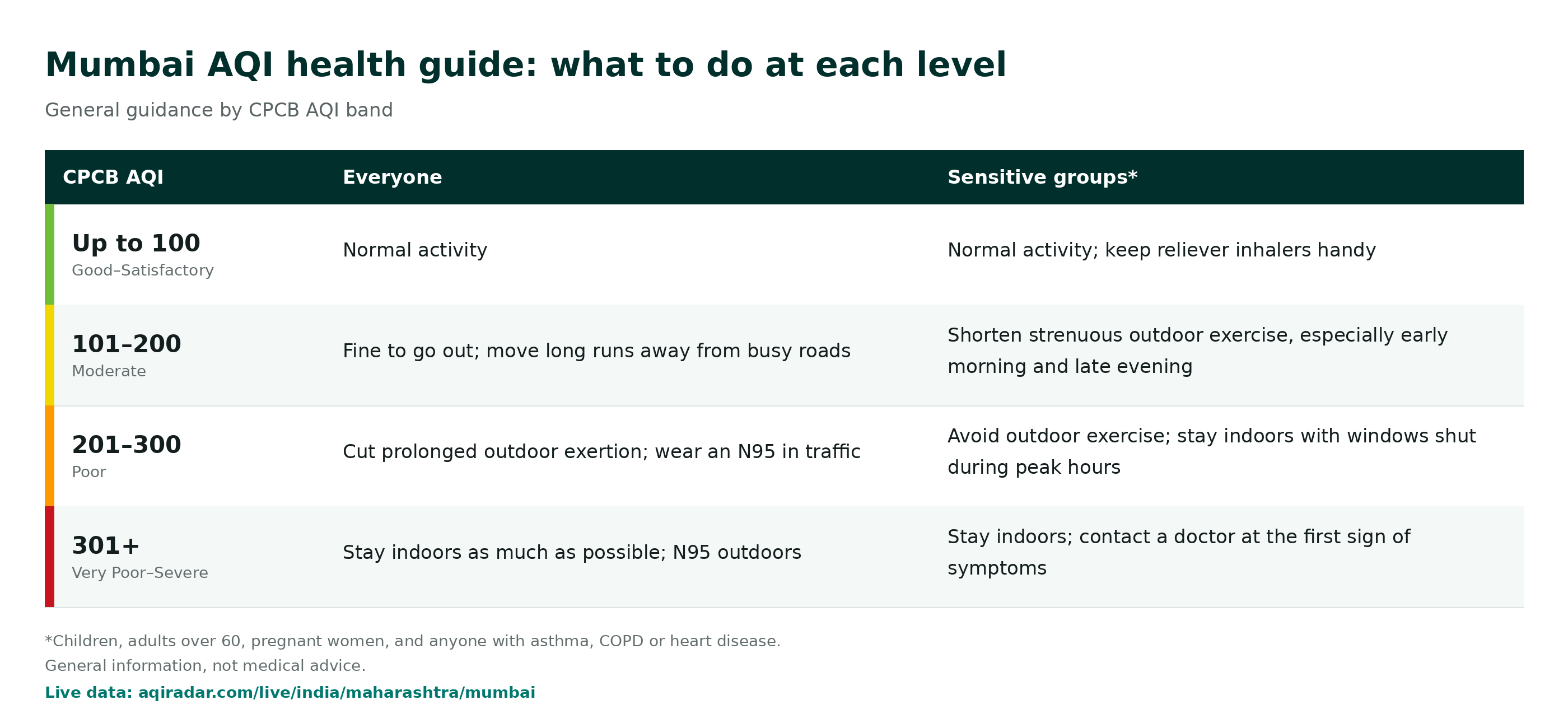
*Children, adults over 60, pregnant women, and anyone with asthma, COPD or heart disease.
Practical tips for Mumbai:
Time your outdoors. Readings swing sharply within a day. Recent data showed the worst levels late at night and the best in the late afternoon, when sea breezes are strongest.
Use the right mask. Cloth and surgical masks do little against PM2.5. A well-fitted N95 or FFP2 helps on construction-heavy routes and during long commutes.
Keep indoor air clean. Close windows on hazy mornings, avoid burning incense or mosquito coils indoors, and wet-mop instead of sweeping. An air purifier with a HEPA filter is worth it for bedrooms of sensitive family members.
Avoid dust hotspots. Metro, road and building work sites are major dust sources. Pick routes that skirt them when walking or cycling.
Watch for symptoms. Persistent cough, wheezing, chest tightness, or breathlessness on mild effort deserve a doctor's visit — don't wait for a "Poor" day.
Stay hydrated and eat plenty of fruit and vegetables; it won't block pollution, but it supports your airways and overall health.
If you or a family member has a chronic lung or heart condition, ask your doctor for a written plan for high-pollution days before November arrives.
The bottom line
Mumbai's air is "Moderate" today, but the cleaner monsoon months are over. Slower winds, drier air and restarted construction will push more days into the "Poor" range by November.
To stay ahead of it, check live, station-level readings on AQIRadar's Mumbai page (aqiradar.com/live/india/maharashtra/mumbai) and the official data on CPCB's Sameer app or the CPCB AQI bulletin, and look at your nearest station rather than the city average. Plan workouts and commutes around the cleaner hours, and get masks and purifiers sorted before the festive season. Clean air in Mumbai this winter depends as much on enforcement at construction sites as on the weather — so reporting dusty sites to your ward office helps too.
Sources
Free Press Journal — BMC unveils 2026 Action Plan (Oct 2, 2026)
Bombay Samachar — BMC Action Plan 2026 targets dust, hotspots
Urban Acres — Mumbai weather to get warmer as monsoon withdrawal begins
The Hindu via PressReader — Bombay HC calls for preventive measures
Deccan Herald — Experts raise concern about Mumbai's air quality
Deccan Herald — BMC committee on worsening air quality (2023)
Hindustan Times via PressReader — What pollutes Mumbai's air
Hindustan Times via PressReader — Air quality remains poor (2023)
Hindustan Times via PressReader — Humidity and poor air (2019)
AQI readings change hourly. Figures above reflect October 1–4, 2026. This post is general information, not medical advice.
mumbaiaqi