11 August 2026 · Faheem M
How to Reduce PM2.5 Inside Your Home | Evidence Based Practical Guide
Learn practical, evidence-based ways to reduce PM2.5 inside your home. Discover how cooking, outdoor pollution, ventilation, air purifiers, HEPA filters, and HVAC filtration affect indoor air quality—and what you can do to breathe cleaner air.

Introduction
Staying indoors does not automatically mean you are protected from PM2.5. Fine particles can enter from outdoor air, while cooking, smoking and combustion can create additional particles inside the home. The most effective approach is to reduce pollution at its source, manage ventilation according to outdoor conditions, and use appropriate filtration when needed.
The World Health Organization defines PM2.5 as particulate matter with an aerodynamic diameter of 2.5 μm or less and identifies fine particulate matter as a pollutant with major health relevance. WHO: Guidance on air pollution and health
Key Takeaways
Control indoor pollution sources first, especially smoke and cooking emissions.
Do not automatically open windows for ventilation; check outdoor air quality first.
A properly sized portable air cleaner can substantially reduce indoor PM2.5.
CADR matters more than simply choosing a purifier advertised for a large room.
For compatible central HVAC systems, MERV 13 or the highest compatible filter can improve particle filtration.
Replace filters according to manufacturer guidance and inspect them more often during heavy-pollution periods.
During severe outdoor pollution, combine source control, closed-window operation and filtration rather than relying on a single measure.
Useful AQIRadar Guides
For background on indoor and outdoor pollution, see Indoor vs Outdoor Air Quality: Understanding AQI, Pollutants, and Home Solutions. For particulate-matter basics, see PM2.5 vs PM10: What's the Difference?. For AQI interpretation, see What Is AQI? Complete Guide for Indians.
If you are choosing an air purifier, use the AQIRadar Air Purifier Calculator to estimate CADR and air-change requirements.
1. Understand Where Indoor PM2.5 Comes From
Indoor PM2.5 can come from outside or be generated inside the home. Outdoor particles can enter through windows, doors and small openings, while indoor activities such as cooking and combustion can create additional particulate matter.
The EPA notes that indoor particulate levels depend on outdoor concentrations, infiltration, ventilation and filtration systems, indoor sources and occupant activities. EPA: Indoor Particulate Matter
Common indoor sources include cooking, combustion, candles, fireplaces, unvented heaters and tobacco smoke. EPA: Sources of Indoor Particulate Matter
2. Control Indoor Sources First
Source control is important because preventing particles from being generated is often easier than trying to remove them after they have spread throughout a room.
Cooking can raise indoor PM2.5
Cooking can increase indoor particle concentrations, with emissions varying according to the food, cooking method and cooking fat. Frying, grilling, sautéing and burning food can produce particularly high particle levels.
The EPA recommends using a range hood while cooking, venting it outdoors when possible, leaving it on for 10–20 minutes afterward, and using the back burners when practical. EPA: Cooking and indoor air quality
Turn the range hood on whenever you cook.
Keep it running after cooking.
Use rear burners when practical.
Avoid burning or deliberately charring food.
Clean the cooking area and hood filter regularly.
Avoid unnecessary indoor smoke and combustion
Smoking, candles, fireplaces and unvented combustion appliances can add particulate matter indoors. Fuel-burning appliances should be properly vented outdoors.
EPA guidance recommends venting fuel-fired combustion appliances outdoors and avoiding unvented stoves, fireplaces and space heaters indoors where possible. EPA: Indoor Particulate Matter
3. Check Outdoor Air Quality Before Opening Windows
Ventilation can dilute indoor pollutants, but it can also bring outdoor PM2.5 into the home. That means opening windows is not automatically the right choice during a pollution episode.
EPA recommends bringing outdoor air indoors when outdoor air quality and weather permit, while using filtration and exhaust strategies when needed. EPA: Cooking and indoor air quality
AQIRadar's Indoor vs Outdoor Air Quality guide explains why outdoor AQI does not directly describe conditions inside a home.
4. Use a Properly Sized Air Purifier
Portable air cleaners can reduce indoor PM2.5, but their effectiveness depends on the purifier, room size, operating time, airflow and pollution source.
A systematic review found that portable air purifiers reduced indoor PM2.5 by 22.6% to 92.0% across the studies included in the review. Cheek et al., 2021 — systematic review
A separate systematic review of real-world personal-level filtration interventions found substantial variation in PM reductions across studies, highlighting the importance of home and equipment conditions. 2021 systematic review — PubMed.
Why CADR matters
CADR, or Clean Air Delivery Rate, describes the amount of filtered air an air cleaner delivers. Higher CADR generally means greater particle-removal capacity and suitability for larger spaces.
EPA provides approximate minimum CADR values for rooms from 100 to 600 square feet, calculated for an 8-foot ceiling, and notes that larger rooms or higher ceilings may require higher CADR. EPA: Guide to Air Cleaners in the Home
For a room-specific estimate, use the AQIRadar Air Purifier Calculator.
HEPA filtration
HEPA is a high-efficiency mechanical filtration technology commonly used in portable air cleaners. The performance of the complete air-cleaning system still depends on airflow, CADR, filter size, sealing and operating conditions.
EPA describes HEPA filters as pleated mechanical filters with at least 99.97% removal efficiency for 0.3 μm particles under the specified test conditions. EPA: What is a MERV rating?
5. Run the Purifier Long Enough to Matter
Air cleaners filter air only while air is moving through them. Longer operation and higher fan speeds generally increase the amount of air that passes through the filter.
EPA's air-cleaner guidance explains that higher fan speeds and longer operating times increase the amount of air filtered. EPA: Guide to Air Cleaners in the Home.
6. Consider HVAC Filtration
If your home has a compatible central HVAC system, the system filter can provide another layer of particle filtration.
EPA recommends using a filter rated MERV 13 or as high as the HVAC system can accommodate, and notes that HVAC filters work only when the system is operating. EPA: Guide to Air Cleaners in the Home
Do not assume that every HVAC system can safely accept a higher-efficiency filter. Check the equipment specifications or consult an HVAC professional if uncertain.
7. Maintain and Replace Filters
Filtration is not a set-and-forget solution. Filters need periodic replacement, and heavily loaded filters may affect airflow and performance.
EPA states that filters require periodic replacement and recommends following manufacturer instructions for replacement. EPA: What is a MERV rating?
8. Create a Cleaner-Air Room During Pollution Spikes
During severe outdoor pollution, a practical strategy is to reduce infiltration, avoid creating indoor particles and use properly sized filtration in the room where people spend the most time.
Keep windows and doors closed when outdoor PM2.5 is elevated.
Use a properly sized particle air cleaner.
Avoid smoking, candles and unnecessary combustion indoors.
Use kitchen exhaust whenever cooking.
Keep filters maintained.
For understanding AQI categories and pollution severity, see AQIRadar's What Is AQI? guide.
9. Don't Rely on Unproven 'Natural' PM2.5 Solutions
Houseplants and other products are sometimes promoted as substitutes for proper air filtration. They should not be presented as a replacement for source control, appropriate ventilation or mechanical particle filtration when PM2.5 is elevated.
What Does the Research Actually Say?
A systematic review of portable air purification studies reported PM2.5 reductions between 22.6% and 92.0%, although health-outcome evidence was limited and inconsistent. Cheek et al., 2021 — PubMed
A randomized crossover study conducted in 29 homes found mean PM2.5 reductions of 78.8% in primary rooms and 57.9% in secondary rooms when HEPA-equipped portable air cleaners were used. Real-world portable air cleaner study — PubMed
These figures should not be interpreted as a guarantee for every home. Real-world performance varies with room volume, air leakage, pollution sources, purifier CADR, placement and operating time.
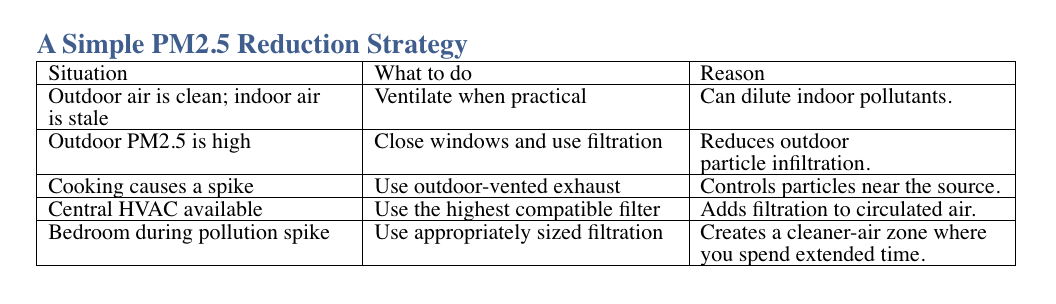
A Simple PM2.5 Reduction Strategy
Frequently Asked Questions
Does an air purifier remove PM2.5?
Yes. Effective particle air cleaners can reduce indoor PM2.5, but the amount removed depends on CADR, room size, operating time, filtration and pollution sources.
Should I keep windows closed when AQI is high?
When outdoor PM2.5 is elevated, keeping windows closed can reduce infiltration. When outdoor air is cleaner, ventilation can help dilute indoor pollutants.
Is HEPA enough for PM2.5?
HEPA filtration is highly effective at capturing particles under its specified test conditions, but purifier performance also depends on CADR and airflow.
How long should I run an air purifier?
Longer operation generally filters more air. During pollution episodes, extended operation can provide more consistent filtration.
Can one purifier clean the whole house?
A portable unit works most predictably in the room where it operates. Larger homes may require multiple units or a suitable central filtration strategy.
Does cooking increase indoor PM2.5?
Yes. Cooking can generate fine particles, particularly with frying, grilling, sautéing and burning food.
The Bottom Line
Reducing PM2.5 indoors is not about finding one perfect product. It is about controlling the sources and pathways that determine your exposure.
Start by reducing indoor particle sources, especially cooking emissions and smoke. Check outdoor air quality before ventilating. When outdoor pollution is high, reduce infiltration and use effective filtration. If you have central HVAC, consider the highest compatible filter and maintain it regularly.
To understand how PM2.5 fits into overall air-quality readings, see PM2.5 vs PM10: What's the Difference? and What Is AQI? Complete Guide for Indians.
References
WHO — Guidance on air pollution and health
WHO — Global Air Quality Guidelines
EPA — Indoor Particulate Matter
EPA — Sources of Indoor Particulate Matter
EPA — Cooking and Indoor Air Quality
EPA — Guide to Air Cleaners in the Home
PM2.5