2 September 2026 · Faheem M
Why Does AQI Change Every Day? Understanding the Science Behind Daily Air Quality Changes
AQI can change dramatically from one day to the next—and sometimes within just a few hours. Weather, traffic, wind, temperature inversions, sunlight, rain, wildfires, dust, and atmospheric chemistry all influence how pollutants build up, disperse, or transform. In this guide, discover the science behind daily AQI changes, which pollutants drive them, and how to understand what today’s AQI really means for you.

Have you ever checked the air quality in the morning and found an AQI of 70, only to see it climb above 150 later in the day?
Or wondered why the AQI can be high one day and surprisingly low the next—even when you are in the same city?
The answer is that AQI is not a fixed property of a place. It reflects the concentration of pollutants in the air at a particular time, and those concentrations constantly respond to emissions, weather, atmospheric chemistry and pollution transported from elsewhere.
Traffic, industrial activity, construction, fires and dust can add pollutants to the atmosphere. Wind can disperse them. Rain can remove particles. Temperature inversions can trap them close to the ground. Sunlight can trigger chemical reactions that create new pollutants such as ground-level ozone.
That is why yesterday's AQI doesn't necessarily tell you what today's air will be like.
In this guide, we'll explain why AQI changes every day, which pollutants are responsible, how weather affects pollution, and how to interpret a sudden change in AQI.
What Is AQI?
The Air Quality Index (AQI) is a communication system that converts measured concentrations of air pollutants into an easier-to-understand index.
The U.S. EPA's AQI ranges from 0 upward, with higher values representing greater pollution and greater health concern. The familiar categories are:
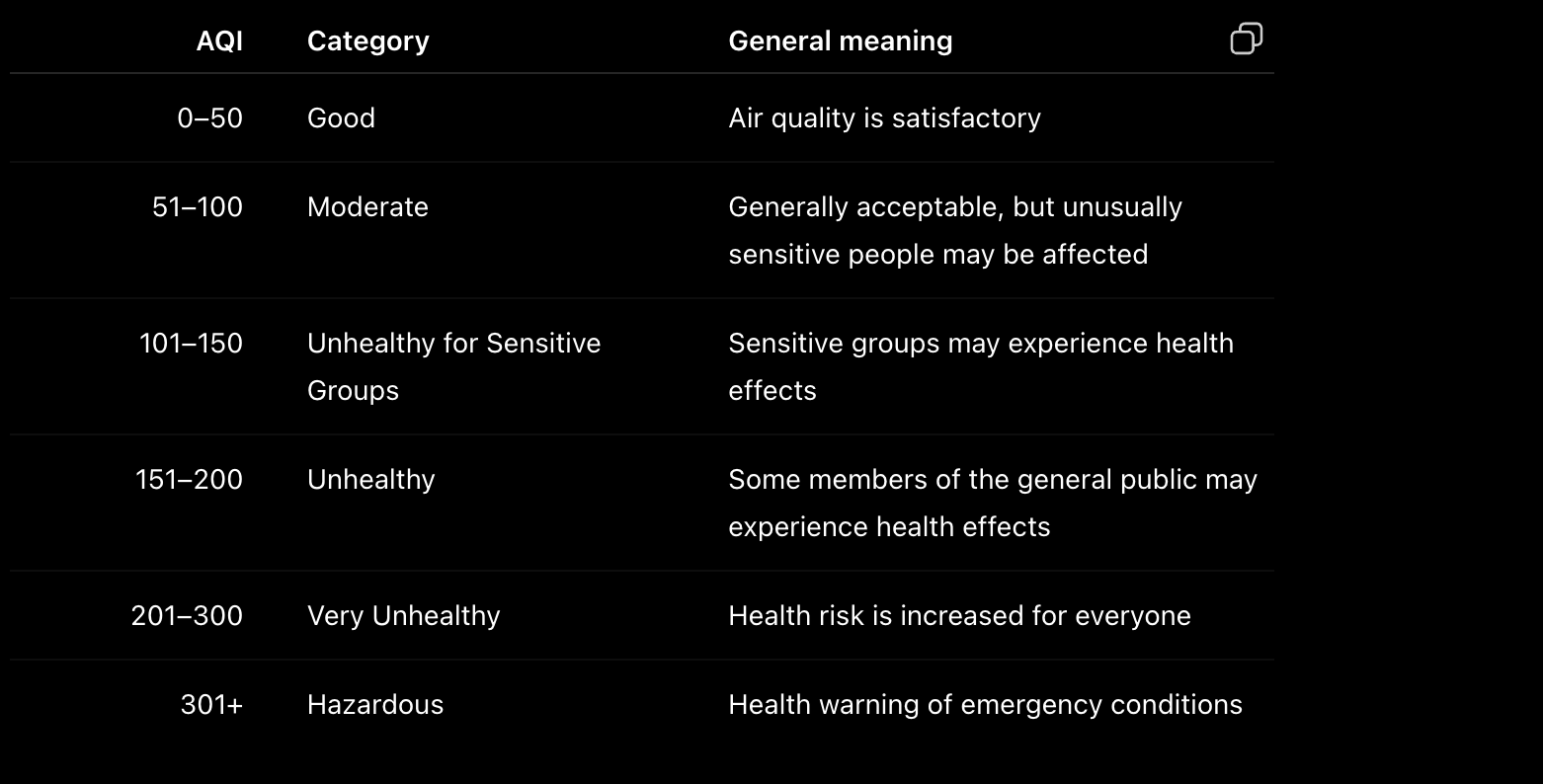
These categories are part of the U.S. EPA's AQI system.
Importantly, AQI is not a measurement of a single pollutant.
The AQI can incorporate:
PM₂.₅
PM₁₀
Ground-level ozone (O₃)
Carbon monoxide (CO)
Nitrogen dioxide (NO₂)
Sulfur dioxide (SO₂)
Each pollutant can produce its own AQI sub-index, and the pollutant with the highest applicable index determines the reported AQI.
So when the AQI changes, the first question should be:
Which pollutant caused the change?
That often tells you much more than the AQI number alone.
Why Does AQI Change So Much From Day to Day?
There isn't one single reason.
Daily AQI is the result of several processes happening simultaneously:
Pollution emissions → atmospheric transport → weather → chemical reactions → pollutant concentrations → AQI
A change in any part of this chain can affect the final AQI.
The biggest factors are:
Traffic and other emissions
Wind speed and direction
Temperature inversions
Atmospheric mixing
Sunlight
Rain
Humidity
Secondary pollutant formation
Pollution transported from other areas
Sudden events such as wildfires and dust storms
Let's look at each one.
1. Traffic Can Change AQI Within Hours
One of the most obvious sources of daily pollution variation is human activity.
Vehicles release pollutants including nitrogen oxides, carbon monoxide and particulate matter. Other sources include industry, power generation, construction, waste burning and combustion.
The exact mixture depends on the location and source.
Traffic also follows a predictable schedule.
Morning and evening rush hours can create periods of increased emissions. If the atmosphere is poorly mixed at the same time, those emissions can accumulate near the ground.
This means a city can experience a noticeable change in pollution over just a few hours.
Weekdays can also differ from weekends
Traffic patterns, industrial operations and other human activities often change between weekdays and weekends.
As a result, pollution patterns can change even when the weather is similar.
2. Wind Can Make AQI Better—or Worse
Wind is one of the most important meteorological factors affecting air quality.
When air moves, pollutants can disperse and become diluted.
But wind does not always mean cleaner air.
Wind can also transport pollution from somewhere else.
For example, a city downwind of an industrial area could experience elevated pollution even if local emissions are relatively low.
The same principle applies to wildfire smoke and regional haze.
So a windy day can produce either:
Cleaner air through dispersion
or
worse air through pollution transport.
The direction and origin of the air mass matter.
3. Temperature Inversions Can Trap Pollution
One of the most important reasons AQI can suddenly become worse is a temperature inversion.
Normally, air near the surface can warm and rise, allowing pollutants to mix upward.
During an inversion, a layer of warmer air sits above cooler air near the surface. This can suppress vertical mixing.
The result?
Pollutants released near the ground can become trapped in a relatively shallow layer of air.
Traffic, cooking, industrial emissions and other sources may continue releasing pollutants while the atmosphere provides little opportunity for them to disperse.
This can cause concentrations to increase significantly.
Inversions are particularly important during stagnant weather conditions and can contribute to elevated particulate pollution.
4. The Height of the Atmospheric Mixing Layer Matters
The atmosphere near the Earth's surface is not always mixed to the same depth.
During the day, solar heating can increase atmospheric turbulence and mixing.
At night, the surface cools and the atmosphere can become more stable, producing a shallower mixing layer.
Think of it like this:
Deep mixing layer → pollutants spread through more air → lower surface concentration
Shallow mixing layer → pollutants concentrated near the surface → higher surface concentration
This helps explain why pollution can behave very differently during the day and night.
However, the exact pattern depends on the pollutant, local emissions and weather.
5. Sunlight Can Actually Create Pollution
It may seem strange that a sunny day can sometimes have worse air quality.
But sunlight plays an important role in atmospheric chemistry.
Ground-level ozone is a classic example.
Ozone near the Earth's surface is not emitted directly in large quantities from most sources. Instead, it forms through chemical reactions involving precursor pollutants such as nitrogen oxides and volatile organic compounds in the presence of sunlight.
As a result, ozone often reaches its highest concentrations during the afternoon.
AirNow explains that ozone pollution is particularly associated with sunny conditions and that AQI values can increase as ozone concentrations rise.
This creates an important difference between pollutants.
A typical pattern might look like:
Morning:
Traffic emissions → higher NO₂ and CO
Afternoon:
Strong sunlight → photochemical reactions → higher ozone
Night:
Reduced sunlight + atmospheric changes → ozone generally decreases
These patterns aren't universal, but they illustrate why the dominant pollutant can change throughout the day.
6. Rain Can Bring AQI Down
Rain can improve air quality, particularly when particulate pollution is elevated.
Raindrops can capture particles in the atmosphere and bring them toward the surface through a process commonly called wet deposition.
Rain can therefore contribute to reductions in airborne particulate concentrations.
But the effect depends on:
Rain intensity
Duration
Wind
Existing pollution
Particle characteristics
Local geography
So you shouldn't assume that every rainfall event will produce the same AQI improvement.
Still, after a substantial rain event, it is common to see particulate pollution decrease when atmospheric conditions also support dispersion.
7. Humidity Can Change Particle Behavior and Chemistry
Humidity affects atmospheric particles in several ways.
Some particles can absorb water from humid air, changing their size and properties.
Humidity can also influence atmospheric chemical reactions, including processes that contribute to secondary particulate matter.
This means the same emissions can sometimes produce different measured pollution concentrations under different atmospheric conditions.
Humidity therefore isn't simply a "good" or "bad" air-quality factor.
Its effect depends on the pollutant and the surrounding atmospheric chemistry.
8. Some Pollution Is Created in the Atmosphere
One of the most important concepts in understanding AQI is that not all pollutants are emitted directly.
Some pollutants form after other substances undergo chemical reactions in the atmosphere.
These are called secondary pollutants.
Ozone is one example.
NOₓ and VOCs can react in sunlight and produce ground-level ozone.
PM₂.₅ can also have a secondary component.
Fine particulate matter can include particles emitted directly from combustion as well as particles formed through atmospheric reactions involving precursor gases.
WHO identifies PM₂.₅ as a major health-relevant pollutant and notes that fine particulate matter can originate from both primary and secondary sources.
This is why AQI isn't always directly connected to what was emitted locally that same hour.
Atmospheric chemistry can continue transforming pollutants after they leave their original sources.
9. Pollution Can Travel From Far Away
The air above a city does not stop at its administrative boundary.
Pollution can travel considerable distances.
For example:
Industrial emissions → atmospheric transport → downwind city
or:
Wildfire → smoke plume → regional transport → distant communities
This means a sudden AQI increase does not necessarily mean that pollution suddenly increased inside your neighborhood.
Wildfire smoke is a particularly clear example. During wildfire events, PM₂.₅ often becomes the pollutant driving the AQI. The EPA notes that during wildland-fire events, AQI commonly represents measured PM₂.₅ concentrations.
Regional transport can therefore make AQI changes seem surprising if you only look at local activities.
10. Wildfires and Dust Storms Can Cause Sudden AQI Spikes
Some AQI changes are caused by short-lived events rather than gradual changes.
Wildfires
Wildfires can release large amounts of particulate pollution and precursor gases.
Smoke can travel far beyond the immediate fire area and cause rapid increases in PM₂.₅.
Dust storms
Dust events can cause sharp increases in PM₁₀ and, depending on particle size and conditions, PM₂.₅.
Other events
Sudden pollution changes can also occur because of:
Large construction activity
Waste burning
Industrial incidents
Traffic congestion
Agricultural burning
Local fires
When an AQI suddenly jumps, checking the dominant pollutant and local conditions can help identify the likely reason.
Why Is AQI Sometimes Worse at Night?
This is a common source of confusion.
People often assume air quality should automatically improve at night because traffic decreases.
But the atmosphere also changes.
At night:
Surface temperatures decrease.
Atmospheric mixing can become weaker.
The boundary layer can become shallower.
Pollutants can accumulate near the ground.
Temperature inversions can develop.
Some pollutants follow different chemical pathways.
At the same time, ozone generally decreases after sunset because its production depends heavily on sunlight.
So nighttime air quality can involve competing effects.
For example:
PM₂.₅ may increase while ozone decreases.
The overall AQI depends on which pollutant produces the highest applicable index.
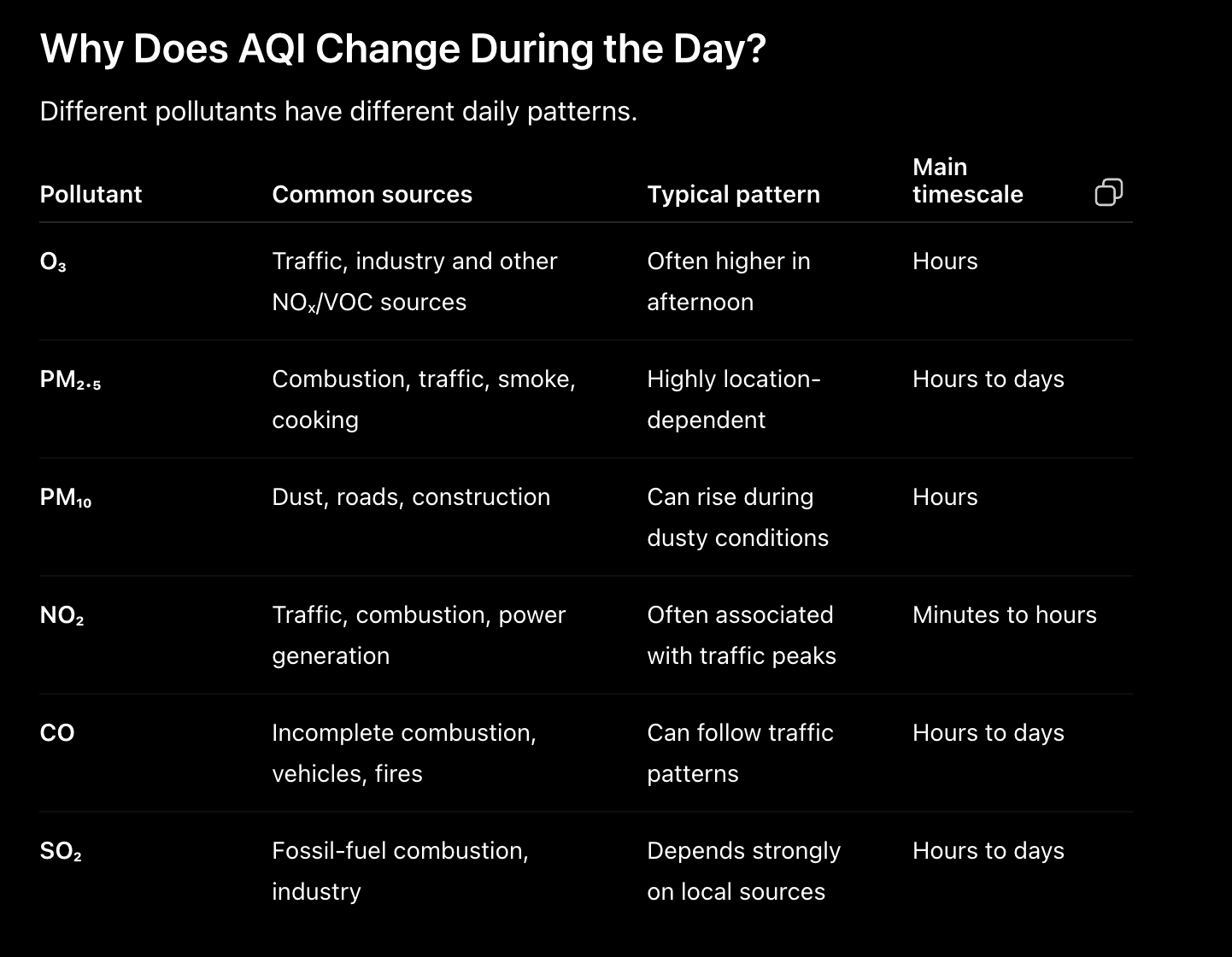
These are typical patterns, not universal rules.
Local geography, weather, emission sources and season can change them significantly.
Why the AQI Number Alone Doesn't Tell the Whole Story
Suppose today's AQI is:
AQI 150
That tells you that air pollution has reached a level associated with increased health concern.
But it doesn't tell you everything.
You should also ask:
Which pollutant is responsible?
Is it:
PM₂.₅?
PM₁₀?
Ozone?
NO₂?
Another pollutant?
When did it peak?
A PM₂.₅ episode caused by overnight stagnation is different from an afternoon ozone episode.
Is it getting better or worse?
A single AQI value is a snapshot.
Looking at the trend can provide much more context.
How Is AQI Actually Calculated?
AQI isn't simply the average of all pollutants.
For each pollutant, the measured concentration is converted into a pollutant-specific index using defined concentration breakpoints.
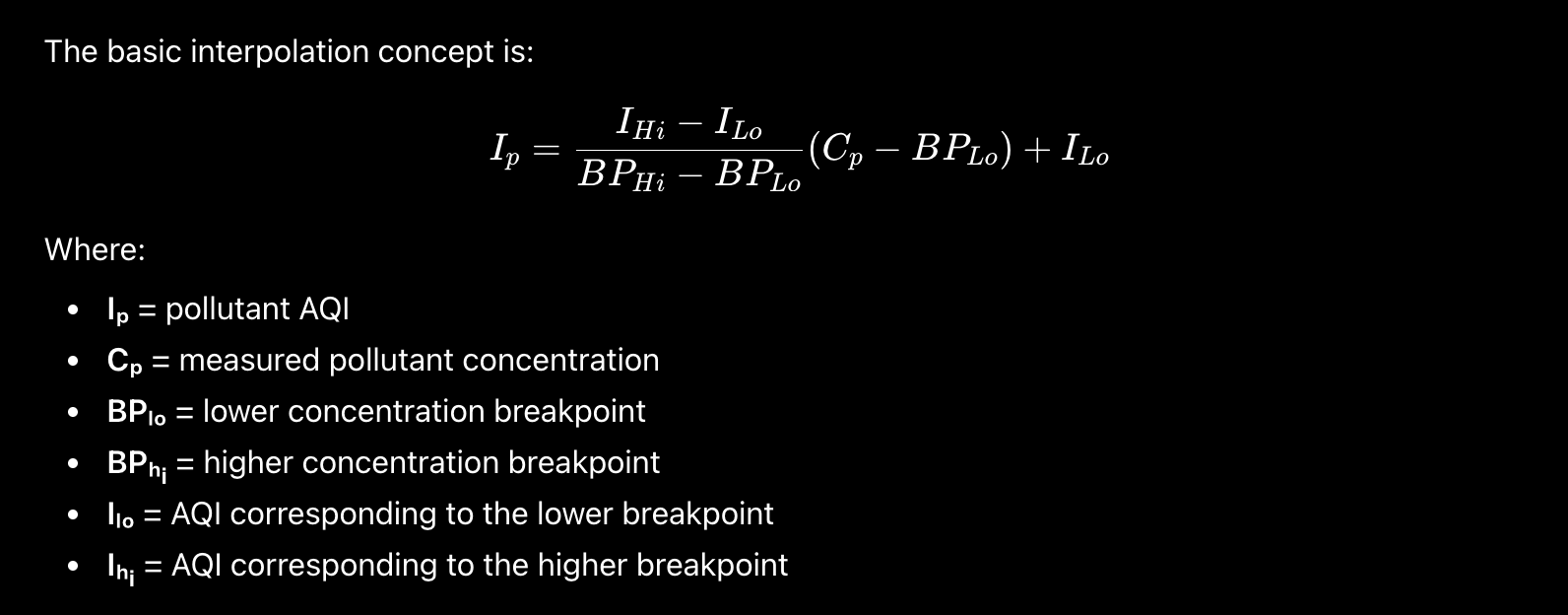
The resulting pollutant sub-index is then compared with the other applicable pollutant indices.
The highest applicable index determines the reported AQI.
EPA provides the current AQI calculation methodology and breakpoint tables.
Important: AQI breakpoints can change
This is particularly important when comparing historical AQI data.
The EPA states that current AQI breakpoints are used in AirData AQI summaries regardless of the year requested.
So older articles or datasets may contain breakpoint values that don't match the current U.S. EPA system.
AQI Is Not the Same Everywhere
Another important point is that AQI is not a universal global scale.
The U.S. EPA has its own AQI system.
India, China, Europe and other regions use their own air-quality reporting systems and pollutant thresholds.
Therefore, an AQI value from one country's system should not automatically be interpreted using another country's categories.
When checking AQI, always identify which AQI system is being used.
Why Two Nearby Places Can Have Different AQI
You might notice that two neighborhoods in the same city report different air-quality readings.
That's possible because pollution isn't distributed uniformly.
Differences can result from:
Traffic density
Industrial sources
Construction
Local topography
Wind direction
Monitoring-station location
Distance from pollution sources
Local weather
Regional pollution transport
A monitor near a busy road may experience different pollutant concentrations from one located in a residential area.
This is one reason AQI should be interpreted as an indicator for a particular monitoring area—not necessarily an exact measurement of the air at every street corner.
Does a High Outdoor AQI Mean My Indoor Air Is Also Bad?
Not necessarily—but outdoor pollution can influence indoor air.
Indoor air quality depends on additional factors such as:
Outdoor pollution entering the building
Ventilation
Cooking
Combustion
Tobacco smoke
Indoor particles
Filtration
Building characteristics
AQIRadar's guide on Indoor vs Outdoor Air Quality explains why outdoor AQI should not be treated as a direct measurement of bedroom or indoor air quality.
If PM₂.₅ is your main concern, our guide on How to Reduce PM2.5 Inside Your Home covers source control, ventilation and filtration strategies.
And if you're interested in filtration specifically, see HEPA Filters Explained Simply.
What Should You Do When AQI Suddenly Gets Worse?
The appropriate response depends on how high the AQI is, which pollutant is responsible, and your circumstances.
The EPA recommends using AQI categories to understand when air pollution may pose increased health risks.
When AQI is elevated, practical steps can include:
Checking the dominant pollutant.
Reducing strenuous outdoor activity when recommended.
Following local air-quality alerts.
Keeping track of whether pollution is increasing or decreasing.
Limiting exposure during severe pollution episodes.
Using appropriate indoor filtration when particulate pollution is a concern.
Avoiding unnecessary indoor pollution sources.
For particle pollution, EPA specifically recommends using air-quality alerts to help reduce exposure when PM reaches harmful levels.
People with existing health conditions should follow advice from their healthcare professionals and local public-health authorities.
Does a Low AQI Always Mean the Air Is Completely Safe?
Not necessarily.
AQI is a communication tool designed around specific pollutants, concentrations and health thresholds. It should not be interpreted as a guarantee that there is zero health risk.
The WHO's air-quality guidelines are health-based recommendations for pollutant concentrations and are distinct from AQI systems. WHO emphasizes that exposure to air pollution can affect health even at relatively low concentrations.
This is another reason to think of AQI as a useful indicator, rather than a perfect description of every aspect of air quality.
The Simple Explanation: Why Does AQI Change Every Day?
If you remember only one thing, remember this:
AQI changes because the amount of pollution in the air changes—and weather determines how that pollution moves, mixes, reacts and disappears.
A simple way to visualize the process is:
Pollution sources
↓
Traffic, industry, fires, dust, combustion
↓
Pollutants enter the atmosphere
↓
Wind + temperature + humidity + atmospheric mixing
↓
Pollutants disperse, accumulate or travel
↓
Sunlight + atmospheric chemistry
↓
Secondary pollutants can form
↓
Measured pollutant concentrations
↓
AQI calculation
↓
Reported AQI
That's why the same city can have:
AQI 60 → AQI 140 → AQI 80
over a few days without anything "mysterious" happening.
The atmosphere is constantly changing.
Final Takeaway
A changing AQI is normal because air pollution is a dynamic system.
Traffic and industrial emissions can change from hour to hour. Wind can disperse pollutants or transport them from somewhere else. Temperature inversions can trap pollution close to the ground. Sunlight can drive ozone formation. Rain can remove particles. Wildfires and dust storms can cause sudden spikes.
And because different pollutants behave differently, the pollutant driving today's AQI may not be the same pollutant driving tomorrow's.
So instead of looking only at:
"What is today's AQI?"
also ask:
"Which pollutant is driving it?"
"Is the AQI increasing or decreasing?"
"What is the weather doing?"
"Is this local pollution or pollution transported from elsewhere?"
Understanding those factors makes AQI much easier to interpret—and helps you make better decisions about when and how to reduce your exposure.
For more AQI explainers and practical air-quality guides, explore the AQIRadar Resources.
References
U.S. Environmental Protection Agency. AQI Basics / Air Quality Index.
U.S. Environmental Protection Agency. How Is the AQI Calculated? Updated June 25, 2026.
U.S. EPA Air Quality System. AQI Breakpoints. Updated August 27, 2026.
U.S. EPA. AirData Basic Information.
U.S. EPA. Communicating Air Quality Conditions: The Air Quality Index.
U.S. EPA. Particulate Matter (PM) Basics. Updated May 21, 2026.
World Health Organization. Air Pollution.
World Health Organization. WHO Global Air Quality Guidelines. 2021.
World Health Organization. Air Quality and Health: Types of Pollutants.
U.S. EPA. Frequent Questions About Wildland Fire Smoke for Individuals.
aqichange